Don’t Get It Twisted
Because straights lines don't exist in nature

A few weeks ago I was in a room with a group of founders. Different backgrounds, different industries, different stories about how they got there.
We were doing the work that requires people to slow down and look at what’s actually driving them.
At some point in the conversation, someone said something easily, without thinking. It landed in the room like a dropped glass.
They weren’t being unkind, they just couldn’t see the effect of their words.
I’ve been reflecting on that moment ever since, processing, trying to find the right words for what I watched happen.
There’s an exercise used in diversity work called the Privilege Walk. You line people up.
A facilitator reads out statements — if your parents owned their home, step forward; if you grew up in a single parent household, step back; if you’ve ever changed how you speak to be taken more seriously, step back.
Statement by statement, the line dissolves. Some people are ten paces ahead. Some are ten paces behind.
By the end, the room has rearranged itself into a picture that was always true but rarely seen.
One facilitator I came across stopped running it. Not because the intention was wrong, but because it kept producing shame without anywhere for that shame to go.
The people at the front felt exposed and guilty. The people at the back felt seen, and also somehow responsible for the discomfort of the people at the front.
The gap was visible, the bridge wasn’t.
What I want to say is that you don’t need the exercise for that dynamic to appear.
It’s already in the room, already in the workshop, already in the boardroom. Most of us just don’t have a name for it.
I should say where I stand before I go further.
I’m a Black British man. My family is Jamaican. My parents’ generation was invited to this country after the war — needed, welcomed in that particular kind of way when you don’t feel welcomed at all, and then never treated as fully belonging here.
I grew up with this as my history. I know what it is to do a quiet calculation before I’ve said a word in a room.
Also I know the privilege afforded to me. As a man, certain assumptions work in my favour. Relatively speaking, compared to some of my own family and others I know, I’ve had a fortunate life.
I’m not throwing shade at anyone. I’m being honest about where I stand in the picture, because I think that matters before I say what I’m about to say.
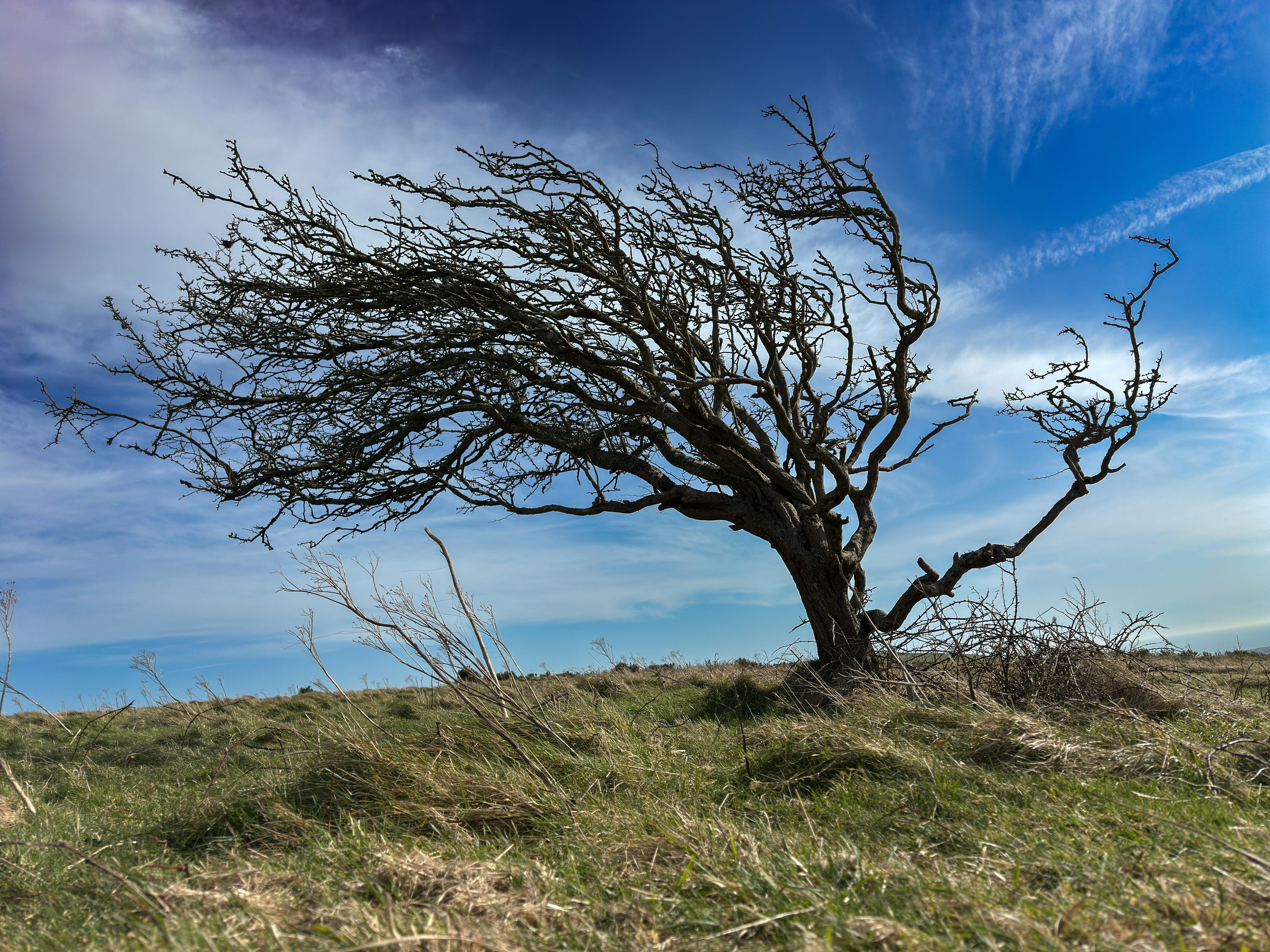
In exposed places — high moorland, coastal edges, you find trees that have been shaped entirely by the wind.
They don’t grow straight, they lean. Their branches reach in one direction, bent and held there over years by pressure they didn’t choose.
If you didn’t know what you were looking at, you might call them stunted.
But they’re completely healthy trees. They just grew in conditions that required them to conform and adapt to the harsher environment and the constant assault that comes with it.
Put one of those trees next to a tree that grew in a sheltered garden. Fed, tended, protected. That tree goes straight up. It looks like what we’ve decided trees are supposed to look like.
Neither tree chose its conditions. One spent its energy surviving. The other spent its energy growing. Both are doing exactly what trees do.
But they don’t look the same, and they never will, and that’s not a problem to be fixed.
What I see in the rooms I work in is that many of the people I work with are still playing defence.
Founders from the global majority, women navigating spaces that weren’t built with them in mind, people with ADHD or other neurodivergent traits, people who didn’t take the university path, people carrying the weight of intersecting identities.
Not because of something that happened once. They’re playing defence right now, today, every time they walk into a room and do that quiet calculation before they’ve said a word.
Years of experience have wired it in, and no amount of achievement switches it off.
The person who has always played offence often can’t see this. Not because they’re a bad person, but because when the wind has always been behind you, you stop noticing the wind.
You walk through a open doorway without thinking about the door. not waiting to be invited or expecting someone to block your path. When someone else can’t, or takes longer, or approaches it differently, the easiest and lazy read is that something is wrong with them.
That’s where the impatience comes from. The eye rolls, the quiet version of just get on with it that doesn’t know it’s being cruel.
We see this at the highest levels too. Leaders who break their own rules and watch the structures hold them up anyway and that’s not an accident.
It’s what happens when the people who build the systems have never once had to question whether those systems were built for them.
Much of what shapes how we move through the world was laid down long before we had any say in the matter.
The patterns that formed in our earliest years. Around belonging, around safety, around whether we were welcome. They tend to run quietly in the background long after we’ve built things that look like success from the outside.
I hold that opinion loosely, I’m not a clinician, but it maps onto what I see.
The twisted tree doesn’t become the sheltered tree. That’s not the point, the point is to understand what it cost to grow in that wind. To stop reading the lean as a defect, and to start asking what kind of knowledge comes from having held your ground in conditions that weren’t built for you.
That’s what I was watching in the room that day. Two kinds of experience, both real, sitting in the same space with almost no language between them.
What would it mean to build that language — not to make anyone feel guilty, but to make the room genuinely bigger?
I’m Earl Talbot, known as The Resilience Guy. Recoded Resilience is a system through which I guide entrepreneurs and leaders to build from alignment, create from inspiration, and craft a sustainable life on their own terms. Living on purpose, as a SOULpreneur.
This piece was developed with the assistance of an AI language model, used as an editorial companion. The ideas, experiences, and voice are entirely Earl’s — the AI supported the process of shaping and refining them on the page.
I love this reflection Earl